


India’s digital revolution has created unprecedented demand for skilled computer professionals, making the online MCA course one of the most sought-after postgraduate programs in 2025. As the IT industry is projected to grow to $350 billion by 2026, the demand for MCA graduates increases by 15-20% annually. For this reason, acquiring an online MCA degree is ideal for working professionals and recent graduates wanting to advance their online MCA career opportunities while keeping their current responsibilities.
This detailed guide will help you understand the online MCA course available in India, focus on top universities for online MCA course, their admission procedures, opportunities available after completion of the degree and salary prospects in the computer applications field to help you make the most out of your educational investment.
Understanding the Significance of an Online MCA Course in 2025
The 2-year online MCA course degree offers a specialization in advanced computer applications and prepares IT professionals in software development, IT management, and strategic management employing emerging technologies. In contrast to the conventional classroom environment, the online degree utilizes digital technology for instruction, offering unfettered flexibility to study from any location, while maintaining the same level of academic rigor as a traditional classroom instruction program.
Master of Computer Applications (MCA) online program includes courses in advanced programming, software engineering, and database management, cloud computing, artificial intelligence, and cyber security among other computer applications.
The full course of study takes four semesters, during which time students gain an understanding of a range of concepts both through theory and practice in virtual labs, coding assignments, and project work involving case studies from the industry.
Why online MCA has become a trending choice:
Universities offering an MCA (Master of Computer Applications) have nearly doubled from 186 to 336 accredited distance education programs according to the University Grants Commission, and the flexibility to pursue dual degrees aids time and streamlines course work. In addition, the UGC and UGC-DEB have implemented distance education compliance benchmarks which result in a reliable standard of education, further bridging the perception gap between online and traditional degrees. With a recognized qualification, equivalent to other degrees and certifications, the online MCA course has shifted from an alternative to a preferred mode of higher education sought after in the market close to 7 billion.
A recent survey reported 66.7% of major companies and 92.7% of global businesses offering online education actively recruit graduates with an online Master of Computer Applications course, including major companies in the IT and Software industry like Tata Consultancy Services, Google and Microsoft.
Top 10 Universities offering Online MCA Course in India
The university you choose to study with will have the greatest impact on the value of your course. Below is a list of accredited universities recognized by the UGC.
1. Manipal University Jaipur (MUJ)
Manipal University Jaipur provides a consistent and unified distance program with focus areas in Information Technology and Finance. Positioned as the first NAAC A+ accredited institution in Rajasthan while holding the 13th place in the country for top management institutes, MUJ offers value in the form of 10,000+ Coursera courses and professional certificate programs. The fee is ₹1,58,000 covering 2 years payable in flexible EMIs.
2. Sikkim Manipal University (SMU)
It is one of the NS accredited universities established in 2005. It provides one of the most competitively priced online MCA course for ₹98,000 for the entire course. The updated curriculum is designed for working professionals with state-of-the-art facilities. Mock interviews and case studies for job interviews are in emphasis within the curriculum.
3. Chandigarh University Online
Chandigarh University Online offers an online MCA course with specializations i.e. Artificial Intelligence, Cybersecurity, Data Science, Full Stack Development, and Cloud Computing. The fee structure is ₹1,40,000 to ₹2,40,000 which includes weekend classes and 24/7 access to the Course Management System. It has been providing distance education since 2006.
4. JAIN University Online
JAIN (Deemed-to-be University) has an online MCA course with specializations also in AI & ML, Cybersecurity, Data Science. The fee is between ₹1,60,000 to ₹1,95,000, along with a global qualification coupled to the UGC-find Master’s degree.
With more than three decades of experience in academics, JAIN Online has secured placement partnerships with more than 2000 leading companies.
5. Lovely Professional University (LPU) Online
LPU offers an online MCA course with five specializations: Machine Learning & AI, Data Science, Cyber Security, Full Stack Web Development, and AR/VR Game Development. The total fees of the program amount to ₹1,03,040 with 20% student grants and no cost EMI plans. The program offers live lectures and masters classes with industry experts as well as strong placement support programs.
6. Amity University Online
Amity offers the first UGC entitled online MCA in India with specializations in collaboration with TCS Ion. The program costs ₹1,70,000 and spans over 4 semesters, providing 350+ hours of lectures and advanced educational resources. The education and training methodologies are robust and cater not only to working professionals but also beginners helping them advance in their careers.
7. Shobhit University Online
Shobhit University’s online MCA program costs₹1, 12,600 and offers specializations in AI and general computer applications. The program is UGC recognized and AICTE approved, providing tech training and online placement support as well to facilitate entry of students in the IT sector.
8. Uttaranchal University Online
With a NAAC A+ Grade, Uttaranchal University offers online MCA course for ₹96,000 (after 20% scholarship) with 1-on-1 personalized mentorship and integrated LMS with thousands of e-books. The comprehensive job assistance aids students in the final job placements.
In consultation with industry specialists, the curriculum is shaped to acquire the required skill set.
9. Mangalayatan University Online
Mangalayatan University is the most inexpensive online MCA course at only ₹67,000, requiring a minimum of 45% at graduation for eligibility. The university, established in 1985 and located in Aligarh, Uttar Pradesh, is UGC-authorized and gives education of a standard level in online learning, which is flexible.
10. Andhra University Online
With a complete 2-year online MCA course costing ₹76,200, Andhra University is another affordable choice. The program is structured for complete semester-wise coverage, where the first-semester fee is ₹19,800 and the next two semesters are ₹18,800 each. The total fee for international students is US$979.
Online MCA Admission and Eligibility Criteria
It is important to understand the online MCA (Master of Computer Applications) eligibility criteria before applying to any program. While there may be slight variances between universities, most institutions base their qualifications on the UGC-DEB guidelines.
Educational Qualification Requirements:
- A completed Bachelor’s degree (BCA, B.Sc., B. Tech, B.E., or any three-year graduation) from a recognized university.
- General category candidates should possess a minimum of 50% marks in their undergraduate degree, while SC/ST and reserved category candidates should have a minimum of 45% marks.
- Mathematics is a mandatory subject at 10+2 level or during graduation (most universities).
- Candidates can also complete Mathematics bridge courses offered by the university in order to qualify for the program.
Preferred Educational Backgrounds:
- Bachelor of Computer Applications (BCA)
- B.Sc. in Computer Science, IT, or related fields
- B.Tech or B.E. in Computer Science or Engineering
- B.Sc., B.Com. or B.A. with Mathematics at graduation level
Age and Experience Criteria:
No upper age limit for candidates to pursue an online MCA keeps the age accessibility criterion open. Some universities may consider applicants with two years of pertinent work experience as a preference. There are no time restrictions in relation to the completion of the bachelor’s degree, permitting gap-year students and working professionals to fall within the scope of the program.
Entrance Examination Requirements:
Numerous universities provide online MCA courses without the stipulation of entrance examinations, instead, granting merit-based direct admission. Certain institutions, though, may require aptitude exams in areas of mathematical reasoning, logical reasoning, and general knowledge. Prospective students should confirm entrance requirements with their university of choice.
The Stepwise Admission Process for Online MCA is as follows:
MCA admissions is simple and can be done completely online.
Step 1
Online Registration- Go to the university of your choice and fill in the required details to register your name for admission. This includes your name, your education and contact details, and other required information as stated in the admission portal. If required, uploaded relevant academic certificates, a photograph, and a proof of identity (Aadhar, passport etc.).
Step 2
DEB-ID Creation- Log in to the university portal and create your DEB-ID, which can be created using your ABC-ID. You can find your ABC-ID by using the UGC-DEB portal. This is a required step to verify your Admission Eligibility.
Step 3
Application Fee Payment- You can paid the application fee (usually 500-1000 rupees) using a debit/credit card, netbanking, or any other online method. This fee payment is non refundable. Print out the fee payment proof.
Step 4
Document Authentication- Submission of any paperwork which is going to be used for Document Authentication must be completed a few days before the intended date of document authentication. In case document is not authenticated the paperwork must be completed for submission in 2-5 working days.
Step 5
Admission Confirmation- You will be informed about the admission details through e-mail or contact. Details include the fee, payment schedule, and the date your classes are going to start.
Step 6
Payment of Fees- Fees can be paid as a lump sum, in a predetermined number of installments, or by using any other methods the university allows.
To facilitate payments, a number of institutions offer payment facilities for no-cost EMIs.
Step 7
Access Learning Platform- Upon payment of your fees, you will access the university Learning Management System (LMS) which will be provided to you. You’ll be starting your Online MCA Learning Course which will facilitate your orientation sessions and provide you with the course materials.
Necessary Important Documents:
- Mark sheets and certificates for 10th and 12th.
- All semester mark sheets for the bachelor’s degree and the bachelor’s degree certificate.
- Transfer certificate from the last school or college attended.
- Migration certificate (if applicable).
- Category certificate (SC/ST/OBC) for fee concessions.
- Passport-size photographs (digital format).
- Valid government-issued ID proof (Aadhar, PAN, Passport).
- Proof of the subject of Mathematics if not clearly mentioned in transcripts.
Online MCA Course Curriculum and Areas of Specialization
The MCA online curriculum will offer all necessary concepts from basic programming to high-end and new technologies concepts. This will ensure all graduates become ready for the industry. This curriculum is also prepared per UGC-DEB standards and will be applicable to the MCA online program and will include inputs from industry professionals for its sustenance to contemporary market demands.
Curriculum for Each Semester:
Semester 1 Foundation Courses:
- Fundamentals of Information Technology and Computer Organization
- Programming in C and Problem-Solving Techniques.
- Data Structures and Algorithms Fundamentals.
- Database Management Systems Introduction.
- Discrete Mathematics and Mathematical Foundations.
- Operating Systems Concepts.
Semester 2 Core Subjects:
- Object Oriented Programming with Java.
- Advanced Data Structures and Analysis of Algorithms.
- Web Technologies (HTML, CSS, JavaScript).
- Computer Networks and Data Communication
- Principles of Software Engineering
- Practicals and Lab Work of Database Management Systems
Advanced Topics of Semester 3:
- Design and Analysis of Algorithms
- Cloud Computing and Virtualization
- Fundamentals of Cybersecurity and Network Security
- Software Project Management
- Advanced Database Management and Data Warehousing
- Discipline Specific Elective I
- Internship/ Summer Training Project
Specialization and Capstone of Semester 4:
- Artificial Intelligence and Machine Learning
- Mobile Computing and Application Development
- Cryptography and Network Security
- Software Testing and Quality Assurance
- Discipline Specific Elective II
- Major Capstone Project and Dissertation
- Internship in Industry (optional but highly encouraged)
Popular Online MCA Specializations in 2025
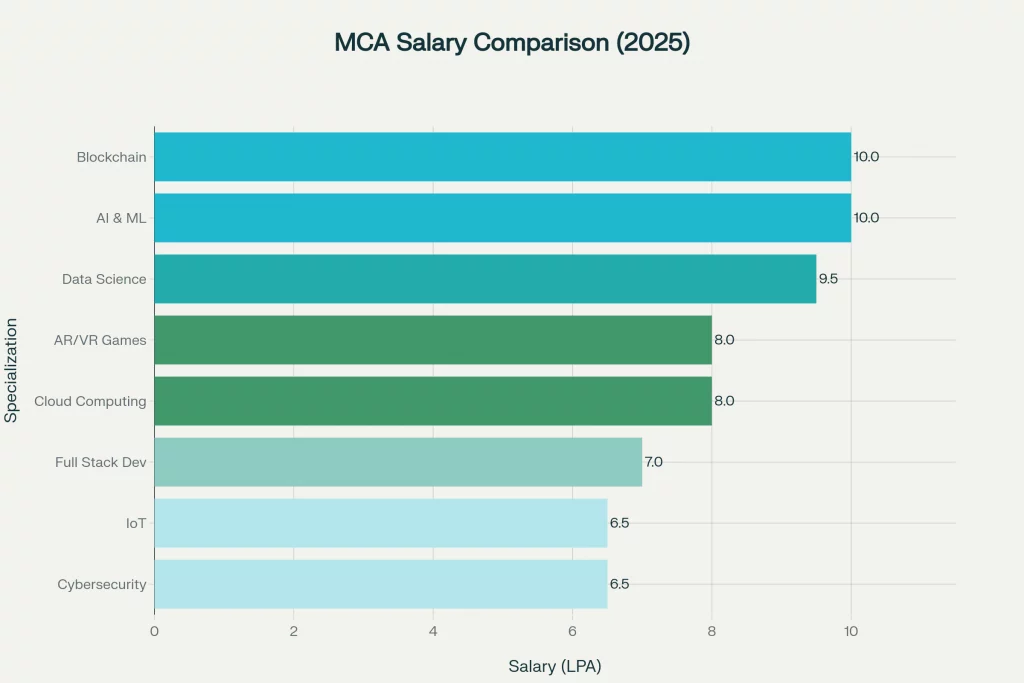
Comparative analysis of starting salaries for popular Online MCA specializations. Notably, AI/ML and Blockchain top the list in 2025.
1. Artificial Intelligence and Machine Learning
This specialization remains in the greatest demand. It encompasses the study of neural networks, deep learning, natural language processing, predictive analytics, and the design of AI systems. AI project work in the curriculum entails the use of Python and TensorFlow. Starting salaries for these professionals fall in the ₹8-12 LPA range. Career prospects also have the highest growth potential. Major employers consist of Google, Microsoft, Amazon and IBM.
2. Data Science and Analytics
This specialization also offers good earning potential. It encompasses the study of data mining, the analysis of big data, the application of machine learning algorithms, and statistical analysis. Data Scientists, Data Analysts, and Business Intelligence Engineers are the primary roles for which the curriculum prepares students. Tools and systems curriculum include Pandas, NumPy, SQL, and Tableau. Graduates from the program begin their online MCA career opportunities with salaries of ₹7-12 LPA.
3. Cybersecurity
This specialization offers starting salaries in the range of ₹5-8 LPA with slower salary growth. Given the increase in cyber threats across the world, this study area provides relevant professional opportunities. Graduates function in roles of Cybersecurity Analysts, Security Consultants, and Chief Information Security Officers. It also teaches ethical hacking, network security, risk management, and security architecture.
4. Cloud Computing
This specialization focuses on Cloud Computing. It prepares students for careers as Cloud Architects, DevOps Engineers, and Cloud Security Engineers. In this program students learn to use Google Cloud, Microsoft Azure and Amazon Web Services with other virtualization technologies. It also includes the teaching of cloud architecture design.
Starting salaries are at a competitive 6-10 LPA, with tremendous growth in potential.
5. Full Stack Web Development
This qualification exposes learners to both frontend technologies (HTML, CSS, JavaScript, React) and backend technologies (Node.js, Python, and databases). This means learners become adaptable and are able to develop and complete web applications. Entry level salaries for this role are at 5-9 LPA and can be found in start-up companies, tech companies or as a freelancer.
6. Blockchain Technology
This specialization focuses on new areas of potential with distributed ledger technology, cryptocurrency, smart contracts, and DApps. Blockchain technology attract top recruitment at financial technology companies and other large companies such as IBM, Oracle, and in tech start-up with starting salaries of 8-12 LPA.
7. AR/VR and Game Development
This work exposes students to augmented reality and virtual reality technologies, 3D modelling, and game development and interactive media design. This field offers career opportunities in gaming studios and large companies such as Meta and Microsoft with competitive starting salaries of 6-10 LPA.
8. Internet of Things (IoT)
This work prepares students for the connected world. This work opportunities are at Bosch, Samsung, and other tech companies starting salaries are at 5-8 LPA.
Career Opportunities and Salary Expectations After Online MCA
With the IT industry growing at a rate of 15-20% yearly, the scope of online MCA is ever expanding.
Data from Naukri indicates there are currently around 16,734 job postings for MCA graduates as of April 2025.
Some of the Top Career Options After Completing MCA Online:
- Software Developer/Engineer – Most MCA graduates begin their careers in this role by developing, designing, and maintaining software applications. Java, Python, SQL, and strong problem-solving skills are fundamental to this role. The starting salaries range from ₹3.5 to 6.5 LPA and with experience, the salaries increase to ₹10 to 15 LPA.
- Data Scientist – This job is one of the highest paying jobs. Data Scientists help organizations by making data-driven decisions and perform complex data analytics. This role requires Python, machine learning, and statistical analysis. The salaries for this position start from ₹6 LPA and can go up to ₹20 LPA and more for professionals with experience.
- Cloud Architect – These professionals create and manage cloud architecture on AWS, Azure, or Google Cloud. The salary range for Cloud Architects is between ₹8 to 18 LPA.
- Cybersecurity Analyst – These professionals protect computer systems and and data from digital threats. The assess security, perform risk analysis, and ethical hacking. The salary for this job ranges from ₹5 to 12 LPA.
- System Analyst – These professionals help an organization improve its IT systems. The average salary for this position is ₹5 to 10 LPA.
- Database Administrator – These professionals are responsible for the overall management of the database, securing the data, and optimizing the database which involves the use of SQL.
- Average salaries fall between ₹4-7 LPA.
- AI/ML Engineer – Designing and implementing AI systems and machine learning algorithms primarily in Python with technologies like TensorFlow and various neural network architectures. This position is sought after and pays anywhere between ₹8-20 LPA depending on experience.
- Full Stack Developer – Developing and deploying end-to-end web applications. This involves working with client-side technologies like HTML, CSS, and JavaScript, together with other server-side programming. Full stack developers earn ₹5-12 LPA.
- IT Project Manager – Overseeing technology projects involves not just leadership and team management, but also constructing and maintaining an integrated schedule for resources, activities, and project phases. This is primarily within the project management domain and the IT context. IT PMs earn ₹10-20 LPA on senior range.
- DevOps Engineer – Building and implementing Continuous Integration and Continuous Delivery pipelines, as well as automating and controlling systems and environments through Linux, Docker, and other orchestrating cloud tech. Possessing such DevOps skills harness professional compensation around ₹6-15 LPA.
Salary Growth Based on Experience
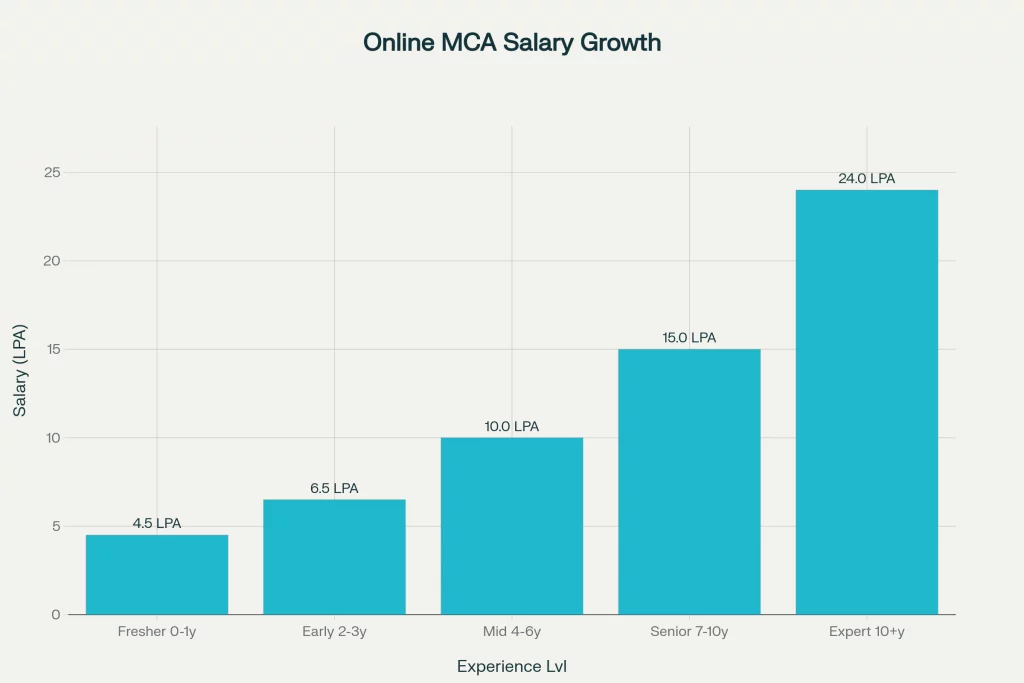
Salary progression chart showing how Online MCA graduates’ earnings increase with experience, from fresher level to expert positions in the IT industry
Freshers (0-1 year): As Freshers, MCA graduates are typically compensated between ₹3.0 to ₹6.0 LPA and can expect to fill roles such as Software Trainee, Junior Developer, and QA Tester. The average starting salary across sectors is approximately ₹4.5 LPA.
Early Career (2-3 years): Roles such as Software Developer, Web Developer, and Database Assistant are offered as jobs and salaries are increased to ₹5.0 to ₹8.0 LPA. Graduates acquire further skills and take on complex responsibilities and projects.
Mid-Level (4-6 years): As Senior Developers, Data Analysts, and System Administrators, Mid-career professionals can expect ₹8.0 to 12.0 LPA. Concentration on high-value disciplines such as AI, cloud computing and data science allows for specialization and increased desired salary. All of which are Mid-career.
Senior Level (7-10 years): Technological Leadership paired with Managerial proficiency provides access to advanced roles such as Tech Lead, Project Manager and Data Scientist. Of which, Senior Professionals can expect to earn ₹12.0-18.0 LPA.
Expert Level (10+ years): Senior Architects, IT Managers and CTOs can earn ₹18.0 to more than ₹30.0 LPA, with top MNCs paying above ₹40 LPA. As strategic thinking and business acumen become more onto par with the technical side, these roles become advanced and focus on high level decision making.
Top Recruiting Companies:
Online MCA Graduates are target recruited by First tier Technology Companies. These companies are:
- IBM
- TCS
- Infosys
- Accenture
- Wipro
- HCL Technologies
- Amazon
- Microsoft
- Cognizant
- Tech Mahindra
- Capgemini
- start-up companies
A large number of universities have established networks of over 300 hiring partners to support placement opportunities.
Global Career Opportunities
MCA graduates have opportunities to work abroad in countries such as the USA, Canada, Germany, Australia, and the UAE. Some of the international positions available are Software Developer (annual salary 60,000-90,000 USD), Data Analyst (50,000-80,000 USD), Cloud Support Engineer (65,000-95,000 USD), and System Administrator (55,000-85,000 USD).
Online MCA Vs Regular MCA
The difference between an online MCA and a traditional MCA should assist prospective students in deciding which aligns best with their situation and desired career.
Course Delivery and Adaptability
Online MCA programs offer education entirely through virtual platforms, which include synchronously and asynchronously lectures, interactive forums, and digital assessments. Automated lectures are available for students who want to study at their own pace, and they can attend weekend live sessions from any location. The traditional MCA requires students to attend classes daily, which included fixed class schedules and a physical presence for labs and lectures.
Prices and Costs
Online programs are generally more affordable, ranging from ₹67,000 to ₹2.4 lakh for the complete course. Students save significantly on accommodation, transportation, and campus infrastructure fees. For Traditional MCA programs, costs are higher due to campus facilities, hostel feeding, and daily commuting costs.
Interaction and Engagement
Online MCA provides a higher level of interaction through discussion forums, video conferencing, group projects, and virtual collaborative tools.
Nonetheless, compared to conventional programs, direct communication opportunities are less available. Participants in campus-based MCAs receive real-time feedback on issues, partake in structured campus activities, and develop relationships with faculty members and peer cohorts. Interactive campus settings also provide opportunities to community members for seamless and instant doubt resolution.
Practical Learning and Labs
As for practical training, online programs integrate virtual labs, coding simulations, and cloud-based development environments for the described hands-on projects. In comparison to these modern features, conventional setups enhance practical training through physical computer labs, unmediated hardware access, and in-depth practical sessions conducted on the campus.
Career Support and Placement
Coaching for placement, including virtual resume crafting, and facilitating connections with 300+ hiring partners, are offered to most online MCA programs. With seamless interaction with recruiters, conventional programs cover to a higher degree placement drives on campus.
Suitability and Ideal Candidates:
Select Online MCA if you:
- Need to enhance your career and are seeking opportunities that won’t interrupt your job.
- Live in remote locations and need access to educational institutions unbarred.
- Have personal engagements that require you to take flexible courses.
- Need to shift educational expenses and gain access remote opportunities to sustain your income. Self-disciplined with a willingness to study online.
Select Traditional MCA if you:
- Need fixed hours of study and pre-scheduled classes.
- Want direct communication and are willing to work on your training intensively for physical access to labs.
- Can manage to relocate and cover cost of campus and conventional learning.
- Benefit from traditional teaching approaches.
Degree Value and Recognition:
Both online and traditional MCA degrees from universities recognized by the UGC carry the same degree of weight with regard to employment in the public and private sectors.
The curriculum, academic rigor, and evaluation standards remain identical across both modes. Employers increasingly recognize online degrees, especially from reputed institutions with proper accreditation.
Benefits of Pursuing an Online MCA Course for Working Professionals
The online MCA for working professionals has emerged as a strategic career investment, offering unique advantages that traditional programs cannot match.
- Unmatched Flexibility and Convenience
Study from anywhere—home, office, or while traveling—without geographical constraints. Access recorded lectures 24/7, allowing you to learn during lunch breaks, evenings, or weekends according to your schedule. Attend weekend live sessions without disrupting weekday work commitments. This flexibility enables you to maintain your current employment, continue earning, and advance your education simultaneously. - Continue Working While Learning
Unlike traditional programs requiring career breaks, online MCA allows you to apply newly learned concepts immediately to your current job. This simultaneous work-study approach provides practical experience alongside theoretical knowledge. You can test learned skills in real work scenarios, enhancing both job performance and academic understanding. Many professionals report 30-50% salary increases after completing online MCA while employed. - Cost-Effective Education
Online MCA course cost significantly less than campus-based alternatives, with fees 30-50% lower in most cases. Accommodation, daily transport, hostel, and relocation costs are either eliminated or minimized. Educational institutions assist with fees through scholarships, no-cost EMI alternatives, and payment plans installment plans every semester. Education and earning simultaneously, as with distance program, adds to the positive outcomes. - Global Faculty and Resources
Renowned international faculty members teach virtual courses no matter where students are located. Numerous digital libraries containing thousands of e-books, research papers, and study materials are accessible at any time. Different students from different parts of the world enhance the learning of global perspectives. Exclusive access to programs that offer Coursera and beyond 10,000 professional certifications is a common feature. - Valuable Curriculum with Specializations
Curricula focused on new specializations in AI/ML, Data Science, Cybersecurity, Cloud Computing, and Blockchain are aligned with market expectations. Knowledge imparted by sector professionals gives job market skills and knowledge. Acquired skills are applied in real-world projects, guided practicum, and industry case study analysis to substantiate learned theory. Additional industry-standard accredited awards along with Microsoft certifications are common with programs. - Personalized Learning at Your own pace
Learning enables students to progress at their own pace by going faster through content they are already familiar with and slowing down on challenging ideas. Lectures are recorded and can be paused and rewound to enhance understanding of critical points. Accommodating varied learning styles and preferences is the essence of asynchronous learning. No need to feel pressured to keep up with classroom pace or to compete with peers. - Improved Career Progression
Obtain in-depth understanding in emerging technology areas which qualifies you for higher level roles. Increase opportunities for promotions and transitions to different roles with enhanced compensation in your present organization. Prepare for higher management positions that require a blend of advanced technical and administrative skills. Gain recognition with a master’s degree from prestigious institutions that global employers acknowledge. - Collaboration and Networking
Engage with individuals from varied fields through virtual forums and interactive discussion groups. Attend online seminars and webinars and engage in discussions with guest speakers from the industry. Forge important contacts in your field through collaborative assignments and peer relationships. Tap into alumni relations that encompass thousands of professionals across more than 20 countries. - Optimum Work-Life Harmony
Eliminate the hassle of daily commuting which frees up 2 to 3 hours for personal study. During your educational pursuits keep your family responsibilities and personal duties. Study at hours which best align with your natural cycles and hours of maximum productivity. You will not need to give up your lifestyle or change the areas you live in. - Equal Recognition and Value
The recognition by UGC- DEB means the online MCA degrees are equal to the traditional degrees in every respect including employment. Both government and private organizations recognize online degrees for employment and within the organization for promotions. Professional bodies and regulatory councils recognize online MCA for further education and certifications. The growing acceptance of online degrees by employers substantiates the legitimacy of these qualifications.
How to Succeed in Your Online MCA Course: Expert Tips
Completing an online MCA course entails different approaches compared to traditional classroom learning. This specifically includes planning, self-discipline, and study methods.
- Set Goals and Study Plan
Each semester, try to identify the goals you want to achieve, then break them to smaller weekly goals. For lectures, assignments, and self-study, prepare a timetable that allocates 8-10 hours. Your goals should be realistic to help you track your progress to avoid stagnation. For time management, you can prioritize your tasks by deadline, difficulty, and importance. - Set Up a Learning Situation
You should establish a study area that is free of distractions, well-lit, and has good ergonomics. For your study area, you should have uninterrupted and reliable fast internet for accessing learning resources and classes. All necessary resources should be organized, such as a computer, textbooks, and notebooks. Control disturbances by informing your family and peers about your study time. - Engage with the Course
For each unit, you should attend all live sessions. This way, you can assess your understanding in the sessions and ask the instructor questions. During the recorded lectures, you should take notes and highlight the concepts. This will help you engage with the material as you prepare for your classes. Engage in discussion boards by asking questions and responding to peers. To consolidate your learning, submit every assignment, quiz, and practical exercise by the due date. - Schedule Regular Coding and Practical Projects
Weekly coding practice on HackerRank, LeetCode or Codeforces should be supplemented by the completion of mini-projects each semester in order to apply your theory. Assemble a portfolio of your coding projects, applications, and other technical works. Engaging in hackathons, coding competitions, and cooperative coding projects is also encouraged. - Use Digital Resources
Organize your coursework and keep track of deadlines using Trello or Asana. Systematically document your notes with OneNote and Evernote. Use GitHub to demonstrate your development projects and offer version control to employers. Supplement your learning with resources like YouTube, online courses, or technical blogs. - Analyze Past Question Papers and Study Accordingly
Past examination papers highlight which questions are asked repetitively and the most important topics. Allocate your study time to high-weightage areas and aim to work on sample questions in a specified time frame to develop your speed and accuracy. Prepare for exams by compiling summary notes on the most important concepts, which are easily digestible for a last-minute review. - Divide the Syllabus into Sections
Each subject should be divided into smaller topics that can be completed in a focused study session of 1-2 hours. Incorporate a consistent study rhythm to prevent overwhelming feelings and improve retention. Avoid cramming and instead review topics weekly to achieve long-term retention and retention understanding. - Expand Your Network and Work with Others
For collective motivation and learning, join online study groups. Use LinkedIn groups, Reddit communities, and Discord servers that focus on MCA and technology. Participate in peer code reviews to examine a wide range of problem-solving skills. To arrange virtual meetups, webinars, and networking events, get in touch with your university. - Don’t Hesitate to Ask
Reach out to your faculty with any questions you may have through emails and virtual office hours. Participate in academic support services, mentorship programs, and doubt-clearing sessions your school provides. When you’re struggling with a topic, you may want to try supplementary videos and additional reading. For career planning and your skillset, get in touch with alumni or older students. - Stay Healthy and Prevent Burnout
Use the Pomodoro technique and take study breaks to avoid burnout. Have a proper sleep routine of 7-8 hours for better concentration and retention. Engage in regular exercise, proper nutrition, and hydration to keep your energy up. Use time outside of school for personal activities, rest, and social time to prevent overload. - Stay Updated with Industry Trends
Engage with technology blogs, podcasts, and newsletters to note newly emerging trends within the area. Subscribe to popular publications within the industry and participate in webinars hosted by prominent figures in technology. Venture with newly emerging programming languages, frameworks, and tools that are beyond the requirement of the curriculum. Become a member of professional bodies and take part in online conferences to augment your understanding. - Prepare Thoroughly for Assessments
Don’t wait for the exam week to start revision and prepare. Develop a detailed revision plan and schedule that leads up to each exam and allocate time for each subject. Learn the topics for understanding and better application instead of rote memorization. This is also important for attempting and solving mock and past exam papers to practice the exam format.
Important Considerations Before Enrolling in Online MCA
To know how to go about choosing your online MCA course and understanding the learning related to it, you need to evaluate a few important aspects that relate to your learning and the outcomes in your career.
Check UGC DEB approval and accreditations
Check that the university you plan to apply to is on the UGC DEB list of approved distance online education institutions. UGC approvals are not permanent, so also make sure the approvals are current for the academic session you are applying to. Make sure to check the NAAC accreditation scored (A++, A+, A) as they show quality and credibility of the institution. For industry recognition, also check for AICTE approval for the technical programs offered.
Assess Quality and Relevance of the Curriculum
Assess the syllabus to check if the course content includes the latest tech advancements to be covered in the course, such as AI, cloud computing, cybersecurity, and data science.
Examine elective options for specialization in your areas of interest. Evaluate the proportion of theory to practice in the curriculum concerning hands-on projects and laboratory work. Examine the extent of partnerships or collaboration with industry and technology firms for curriculum design.
Assess Learning Platform and Technology
Examine the learning management system (LMS) for ease of use and mobile accessibility. Assess whether the system adequately provides live and recorded content to better accommodate learners’ diverse preferences. Evaluate the system for user engagement and support functionality (discussion boards, quizzes, and assignments). Assess support system responsiveness to address user queries.
Investigate Placement Support and Career Services
Examine placement records for the number of students placed and their salary packages. Assess the range of activities offered under the career service umbrella (resume building, mock interviews, and soft skills training). Assess industry ties and the number of companies in the hiring partner ecosystem (preferably 300+). Look for the degree of alumni engagement and gaps in mentorship.
Compare Fee Structure and Payment Options
Compare the overall program costs after accounting for hidden charges, included services, and estimated program length. Look for scholarships, fee waivers, or other forms of financial support. Assess service costs against installment plans, payment schedules, and refund policies. Assess additional costs of ownership from exam, technology, and certification fees.
Review Faculty Credentials and Industry Experience
Examine individual faculty for their credentials, teaching experience, and industry background.
You assess whether international or visiting faculty contribute to learning diversity and analyze faculty members’ availability through office hours, email, and discussion forums. Review programs that include guest lectures by industry experts and practitioners.
Decode Examination and Evaluation Process
Make inquiries regarding the examination format (online proctored, physical centers, or hybrid) and the level of assessments (assignments, projects, quizzes, and final exams) to be analyzed, to be included, and overall ones that will be included for the examination. Inquire about supplementary examination policies, the awarding of grace marks, and rules for mark adjustments. Ascertain the degree issuance date and the method for degree documentation.
Look for Subject Restrictions and Mode Limitations
The Nomenclature of the Commission on the University Grants Commission (UGC) states that, for certain programs, computer applications programs will be allowed in a distance mode. UGC will verify that the specialization you opted for does not fall under the restricted categories of practical-driven intensive. Ask about any compulsory on-site, non-lab, vivas, or presentation in projects. Check on bridge course requirements for non-computer science graduates.
Look for and Verify for a Dual Degree and Check for Credit Transfer
UGC papers will specify and verify that you can do two degrees at a time, one of which can be non-co at a distance. Examine how credit can be acquired or transferred through the Academic Bank of Credits (ABC) system. Verify the option to exit the degree at different stages (pipelines) which will include, and allow, a certificate or diploma for partial completion. Check if the university permits a hybrid (online and offline) mode.
Check for University Papers, Rankings, and Reviews:
Review the university and their papers for which the students have given reviews. Look for NIRF reviews (external university ranking and ratings) and other university ranking and rating systems for credibility.
Examine what the institution has had in terms of regulatory actions, warnings, or issues in compliance in the past. Refine Connections with current students or alumni using LinkedIn to get their take obtained or integrated through Connections with current students or older graduates using LinkedIn to get their opinions.
Future Scope and Industry Trends for Online MCA Graduates
In the context of cutting-edge digital transformation, emerging technologies, and the rapidly developing information technology ecosystem, it seems that the future of the Online MCA in India will be exceptionally positive.
Exponential Growth of IT Industry
The worldwide information technology industry is anticipated to be worth USD 11681.64 billion in 2024, growing at a CAGR of 11% and reaching USD 29886.75 billion by 2033. India’s technology industry alone is projected to be worth USD 350 billion by 2026. This scenario is likely to generate a disproportionate share of industry job opportunities for IT graduates. For the United States information technology and computer technology industry alone, there are 356,700 job openings that will be created annually. This projected job growth directly correlates with the expanding digital footprint of the industry which is rapidly growing in sectors such as healthcare, finance, education, and e-commerce besides the traditional IT e-commerce sectors.
Emerging Technology Domains
Artificial Intelligence and Machine Learning: The Applications of AI and Machine Learning are endless, and there are a multitude of industries and businesses that are willing to pay handsomely for solutions that automate core business processes. AI and ML are integrated with autonomous vehicles, healthcare diagnostics, personalization, and automation of multiple business processes. Organizations will pay a premium for skilled professionals that will develop intelligent systems, build neural networks, and design predictive models. Jobs for AI specialists are expected to grow 40% annually until at least 2030.
Cybersecurity and Privacy: Organizations that are exposed to the internet or that transact digitally face the risk of breaching data or sustaining a loss through bad actors.
The protective digital apparatus constructed by the state and businesses is leading to sustained investment in the profession. The fields of blockchain security, IoT security, and quantum cryptography are examples of newly emerging spheres of security specialization.
Cloud Computing and Edge Computing: With 94% of businesses relying on cloud services, the transformation is well under way to edge computing, which involves working closer to the source of the data. Security, serverless architecture and multi-cloud computing are among the most lucrative cloud skills.
Data Science and Big Data Analytics: Organizations continue to produce staggering volumes of data. Thus, skilled analysts are needed to derive insight from it. The data science industry continues to grow as more businesses begin to integrate data analytics into their decision-making processes. There are now more specialized and lucrative career opportunities within business intelligence, predictive analytics, and data engineering.
The Internet of Things and Smart Systems: By 2025, it’s estimated that there will 75 billion connected devices. This means there will be more opportunities for IoT development. There is a growing need for smart cities, industrial automation, and more consumer IoT applications. There will need to be more embedded systems and wireless sensor network professionals. The merging of AI and IoT (AIoT) provides more opportunities for innovative work.
Blockchain and Decentralized Technologies: While most people know about blockchain due to cryptocurrency, it is also used in supply chain, healthcare records, digital identity, and smart contracts. Other lucrative and innovative opportunities lie within decentralized finance (DeFi) and Web 3.0. They are seeking blockchain architects, smart contract developers, and decentralized application developers.
The Expansion of Remote Work
Remote work has become the new norm in today’s workforce and has opened up new job opportunities for MCA graduates in India. Remote positions often offer compensation in dollars or euros, a considerable amount more than the domestic salary. Global freelancing and remote work have opened up new job opportunities for Indian professionals.
The Need for Continuous Learning
The quickening rate of technological advancements calls for a continuous and intentional approach to skill and knowledge acquisition.
The online Master of Computer Applications (MCA) degree graduates gain the advantages of flexible learning and beneficial program structures during their studies. Additional qualifications like micro-credentials, specialized certifications, and short courses are incorporated. More and more, universities offer their alumni learning materials and content revisions for continuing education.
Entrepreneurship and Innovation
MCA graduates are equipped with the foundational and functional competencies necessary for tech entrepreneurship. For tech founders and early employees, the Indian startup ecosystem, the third largest in the world, offers lucrative opportunities. With the government promoting initiatives like Startup India and the rise of venture capital support, new tech innovations are encouraged. There are countless opportunities in product development, SaaS applications, and tech consulting.
Industry 4.0 and Automation
Manufacturing, traditional industries, and logistics are industries in the midst of a digital transformation for which IT professionals are necessary. Integrating Robotic Process Automation (RPA), industrial Internet of Things (IoT), and smart manufacturing are roles for which job descriptions are now being created. The convergence of IT and Operational Technology (OT) will require professionals who can integrate the two.
Salary and Compensation Trends
Annual starting compensation for specialized MCA graduates (AI, Data Science, Cybersecurity) is ₹8-12 LPA, a considerable premium over the average IT roles. After 5 years in the field, niche tech roles yields ₹15-25 LPA and higher. C-level roles in tech companies in India payment starts from ₹30 LPA plus equity and other bonuses related to the company’s performance. Global positions pay $60,000-150,000 depending on the region and the employee’s skills. With Digital India, Smart Cities Mission, and National Policy on AI, the public sector has more opportunities.
Various Government sectors such as ISRO, DRDO, NIC, and public sector banks hire individuals with an MCA degree. Instances of Digital Governance also require professionals for its implementation and management.
Conclusion: Is an Online MCA Course the Right Choice for You?
The online MCA course is the first of its kind, and for professionals looking to excel in technology, the growth of this sector in India is staggering. The online MCA has, over the years, transitioned from being an alternative to the preferred choice in pursuing higher education with its approved curricula with the added benefits of proximity to the higher education institution, and support in placement.
Knowledge of the program curriculum and the careers associated with it should be the guiding point in deciding to pursue an MCA. The online MCA course has been designed to not only provide core programming knowledge but also advanced technology knowledge in Artificial Intelligence, cyber security, and more. Along with fresh graduates starting at ₹3-6 LPA and expected to excel to ₹18-30+ LPA in a short span, pursuing an MCA is financially justified.
The top 10 universities offering online MCA course in India, such as Manipal University Jaipur, Sikkim Manipal University, Chandigarh University, JAIN University, LPU Online, and Amity University provide an impressive return on investment due to the quality of education, valuable accreditation and industry connections, and reputation. The fees range of ₹67,000 to ₹2.4 Lakh, along with various payment plans, also provide a diverse range of students the opportunity to attend these programs.
For working professionals, the ability to remain employed while pursuing an advanced qualification, the opportunity to apply learned concepts directly to daily work, and the ability to manage work and study make the online MCA course a smart investment in their career.
The expansion of online degrees, coupled with UGC validation ensuring degrees remain equal to traditional degrees, eliminating any concerns regarding the legitimacy of credentials.
Future prospects for online MCA graduates remain positive with the IT industry projected to generate an additional 3 million jobs through 2033 with the additional remote opportunities driven by emerging technologies. Whether your goal is to enter the IT industry as an online MCA graduate, advance your career as a working professional, or pivot to a career in technology, an online MCA course from an established UGC-recognized university will provide a distinct advantage as India broadens the scope of its digital economy.
The cornerstone of fully harnessing your online Master of Computer Applications (MCA) experience is selecting an accredited university, maintaining a proactive schedule of self-directed study, participating in active learning of both the content and collaboration with other learners, creating a comprehensive project portfolio, and taking advantage of any offered career services. With strategic foresight and hard work, an online MCA can become the structuring element of a successful career for you in the IT industry.



Pingback: MCA in Data Analytics: Best Indian Universities 2025